



Modern golf has seen big changes with new tech. These changes have changed how we watch and play the game. Sophisticated tracking systems are now key in assessing performance and broadcasting games.
These systems track every detail of a swing. They show the exact path of each shot. This gives unprecedented clarity on how the ball moves from hit to landing.
Top players and coaches use this tech to improve their game. It helps them fine-tune their skills. Broadcasters also use it to make games more exciting for viewers.
By combining real-time data with graphics, we get transformative insights into golf. This is a big step forward in sports analysis and entertainment.
The Fundamentals of Shot Tracer Technology
Shot tracer technology has changed golf broadcasting. It gives viewers a new look at how balls fly. This tech combines cameras and software to show golf shots live.
Defining Shot Tracer Systems
Shot tracer systems track and show golf ball flight. They use fast cameras and software. This creates the colourful trails we see in golf TV.
They track the ball’s path and calculate its flight. This turns camera data into graphics that help us understand the shot.
Historical Development in Golf Broadcasting
Adding shot tracer tech to golf TV is a big step forward. Early systems had big technical hurdles. Now, they’re much better and reliable.
Early Implementations
In the 1990s, early shot tracing tried to track the ball with cameras and add graphics manually. These systems needed perfect light and often didn’t work well. They were mainly used in big tournaments because they were expensive and tricky.
Related Posts:
- How Technology Affects Urbanization Smart Cities and…

- What Can We Do With Technology Endless Possibilities

- How Technology Is Changing Retail From E-commerce to AI

- What Is Heatwave Technology High-Temperature…

- Technologies Used in E-commerce Platforms and…

- How Many Students Have Access to Technology at Home…

As TV viewers wanted to see more, broadcasters put more money into improving these systems. These early versions helped create today’s advanced technology.
Modern Evolution
Today’s shot tracer tech is much better thanks to new computer vision and faster computers. The PGA TOUR’s work with TrackMan is a big step forward. It brings top-notch shot tracing to TV and online.
Now, systems can process data fast and accurately, even in different weather. This has made shot tracing a standard part of golf TV.
Apps and tools for home use have made this tech available to everyone. Now, even amateur golfers can get the same analysis as pros.
Core Components of Shot Tracer Systems
Modern shot tracer technology uses special equipment that works together well. It combines top-notch imaging with strong computing to show us the golf ball’s flight in detail.
Camera Infrastructure Requirements
The base of any good shot tracer system is its camera setup. This setup must clearly show the golf ball’s path from the clubface.
High-Speed Camera Specifications
For professional shot tracing, high-speed cameras are needed. These cameras can take hundreds of pictures per second. They also have advanced sensors for clear images in any light.
Key specs include:
- Minimum 240 frames per second capture rate
- High-resolution sensors (typically 4K or higher)
- Advanced auto-focus tracking systems
- Low-light optimisation capabilities
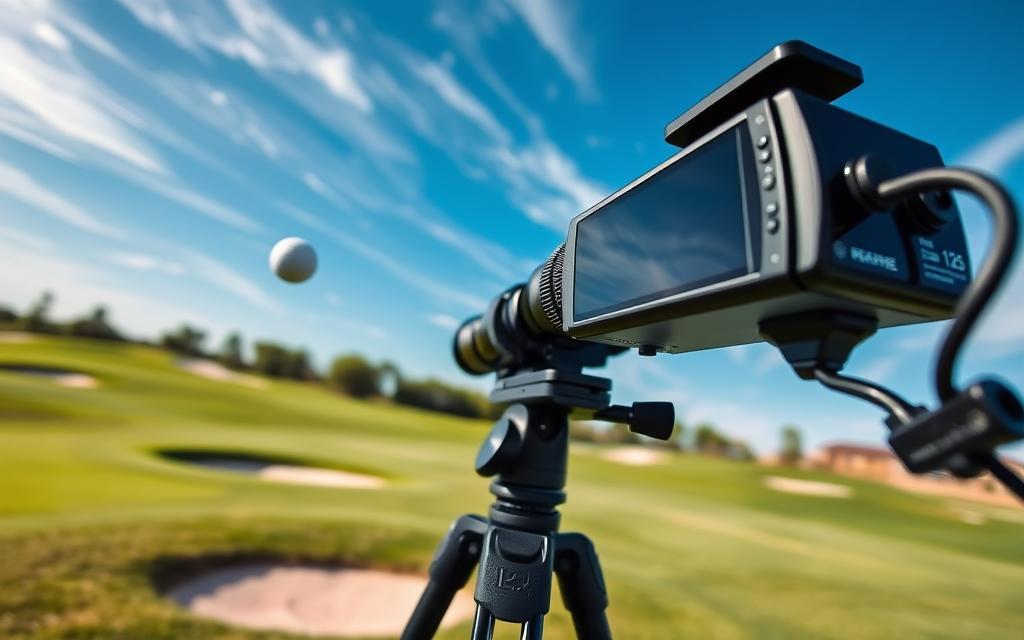
Where cameras are placed is very important for accurate tracking. Systems use several cameras at different angles to the target.
For precise tracking, cameras need to be set up carefully. This includes:
- Camera elevation and tilt angles
- Lens distortion characteristics
- Environmental factors affecting perspective
- Distance markers for scale reference
Processing Hardware
The video data from cameras needs a lot of power to process. Processing hardware is the heart of shot tracer systems.
Today’s systems use strong GPUs and multi-core processors for fast video analysis. The TrackMan system is a great example, using radar and cameras together.
Software Architecture
The software turns raw data into the beautiful tracer lines we see. It uses computer vision and physics to do this.
The software includes:
- Real-time object detection modules
- Trajectory prediction algorithms
- Graphical rendering engines
- Data integration frameworks
Apps like Shot Tracer show how these parts can work well on phones too, keeping accuracy high.
How Does Shot Tracer Technology Work: The Technical Process
Shot tracer technology works through a three-stage process. It turns raw video into beautiful ball flight visuals. This journey starts with finding the ball, then calculating its path, and ends with stunning visuals for broadcasts and training.
Initial Ball Detection Phase
The first step is finding the golf ball against complex backgrounds. Advanced computer vision is used to spot the ball accurately.
Image Recognition Algorithms
Image recognition algorithms scan each video frame for the golf ball. They are trained on thousands of images. This lets them find the ball, even when it’s moving fast or hidden.
Background Subtraction Techniques
Background subtraction removes fixed elements like trees and sky. This makes the moving golf ball easy to track.
Trajectory Calculation Methods
After finding the ball, the system works out its flight path. It uses math and spatial analysis to turn 2D video into 3D trajectory data.
3D Spatial Mapping
The technology uses 3D mapping to show the ball’s position in space. It uses camera angles and course landmarks to create a virtual environment. This allows for accurate distance and height calculations.
Physics Engine Integration
A physics engine simulates real ball flight based on aerodynamics. It considers drag, lift, and spin. This ensures the traced path is accurate, trusted by professionals.
Visual Rendering Process
The final stage turns data into the tracer lines seen in broadcasts. The rendering overlays smooth, coloured trails that follow the ball’s path. This happens in real-time for live shows or quickly for training.
Computer Vision Principles in Shot Tracing
Modern shot tracer systems use advanced computer vision to turn video into detailed ball flight visuals. They combine smart algorithms with strong processing to give accurate results in real-time.

Object Tracking Algorithms
Object tracking is key to shot tracer tech. It uses complex algorithms to track the golf ball from start to finish.
These algorithms work in several ways:
- Kalman filtering for predictive tracking
- Optical flow analysis for movement patterns
- Feature point matching across frames
Top systems like TrackMan keep accuracy high, even when the ball is hard to see or blends with the background.
Pattern Recognition Systems
Pattern recognition tech helps shot tracer systems spot the golf ball among other objects. It looks at shape, size, movement, and colour.
The tech must work well in different situations:
- Different lighting situations
- Various weather conditions
- Multiple background environments
This advanced pattern recognition ensures consistent results in many golfing settings and conditions.
Real-time Processing Challenges
Real-time processing is a big challenge for shot tracer systems. They must quickly process lots of visual data to give instant feedback.
Key challenges include:
- Processing speed requirements
- Data volume management
- System latency minimisation
Systems like Shot Tracer Live use special streaming architectures to meet these demands. They balance complex processing with practical needs.
Improvements in processing hardware help with more detailed real-time analysis. This keeps the quality high for broadcasts.
Data Analysis and Ball Flight Metrics
Modern golf uses advanced tracking systems to capture ball flight metrics. These insights help players and coaches improve performance and choose the right clubs. Professional tours and coaching rely on this data to make informed decisions.
Launch Angle Calculations
The launch angle shows the ball’s initial vertical path after hitting the club. It affects the ball’s peak height and flight. TrackMan uses cameras and radar to measure this angle.
Launch angles vary by club and player skill. Pros hit the ball higher with drivers than amateurs. This angle impacts both distance and accuracy.
Ball Speed Measurements
Ball speed shows the ball’s speed right after hitting the club. It’s a key sign of a good hit and energy transfer. Modern systems measure this with high accuracy, often within 0.1 mph.
Higher speeds mean more distance, but spin rate also plays a big role. Pros hit drivers over 160 mph.
Spin Rate Analysis
Spin rate looks at the ball’s rotation speed in flight. It shapes the shot, controls distance, and affects stopping power on greens. Too much backspin can cut distance but increase height.
Clubs have different spin rates based on loft and impact. Wedges have the highest spin rate, over 10,000 rpm. Drivers have lower rates, 2,000-3,000 rpm for most players.
Carry Distance Projections
Carry distance estimates how far the ball flies before hitting the ground. It uses launch angle, ball speed, and spin rate. Algorithms adjust for wind and air density.
Knowing carry distance helps players choose the right clubs. Pros use this data during tournaments. Amateur golfers learn their true distances with each club.
| Metric | Measurement Method | Professional Range | Amateur Range | Performance Impact |
|---|---|---|---|---|
| Launch Angle | High-speed cameras/radar | 9-12° (driver) | 7-15° (driver) | Determines trajectory height |
| Ball Speed | Doppler radar | 160-185 mph | 130-155 mph | Primary distance factor |
| Spin Rate | Radar tracking | 2000-3000 rpm (driver) | 2500-4000 rpm (driver) | Controls shot shape & descent |
| Carry Distance | Algorithmic calculation | 270-310 yards | 200-250 yards | Club selection reference |
These four metrics create a detailed performance profile. Understanding their connections helps golfers improve their game. Professional systems use these insights to help players at all levels.
Integration With Broadcast Systems
Professional golf productions use shot tracer systems with their broadcast setup. This makes the raw data into graphics that viewers love during TV events.
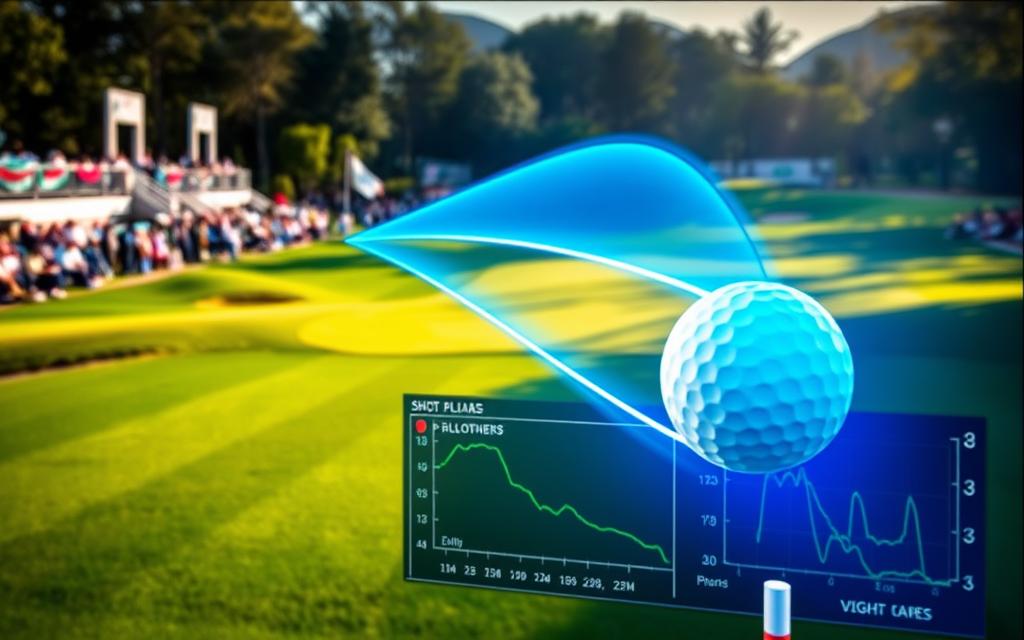
Setting it up needs teamwork between production teams, tech operators, and software experts. Big events like the PGA TOUR have made it work smoothly. They can show real-time shots without stopping the broadcast.
Live Production Implementation
Live golf shows use shot tracer tech in special ways. The PGA TOUR works with AWS to process data fast for TV.
Teams have special operators for each shot. They choose when to show the tracer to keep the show exciting. The system must work well under pressure.
Shot Tracer Live is for streaming. It’s more automatic but keeps the visuals top-notch for online viewers.
Graphics Overlay Techniques
Modern TV uses cool graphics to mix tracer visuals with live video. This makes the ball flight look natural without hiding important details.
Engineers use special techniques to blend the graphics with the video. They match the graphics to the video’s look and feel. This makes the visuals consistent.
Each tournament has its own style but keeps the data accurate. This lets broadcasters offer unique experiences while keeping the shot data true.
| Overlay Technique | Implementation Complexity | Visual Impact | Broadcast Compatibility |
|---|---|---|---|
| Alpha Channel Blending | Medium | High seamless integration | All major broadcast systems |
| Colour Key Compositing | Low | Medium visibility | Legacy systems compatible |
| Real-time Ray Tracing | High | Premium cinematic quality | Next-generation systems only |
| Hybrid Overlay System | Variable | Customisable appearance | Modern HD/4K broadcasts |
Synchronisation With Video Feeds
Getting the graphics to match the video perfectly is key. This keeps the broadcast believable and clear.
Systems use timecode and frame-accurate alignment for perfect timing. This needs fast hardware and smart software to work well.
Engineers keep an eye on timing and make adjustments as needed. They deal with camera moves and light changes to keep everything in sync.
Shot tracer tech works best when it’s perfectly in sync. When it is, viewers see the graphics as part of the show, not just added on.
Practical Applications in Golf Performance Analysis
Shot tracer apps help both pros and weekend golfers improve their game. This tech has moved from just adding to TV broadcasts to being key for serious analysis. Now, coaches and players can see ball flight like never before.

Professional Coaching Uses
Top golf coaches use shot tracing tech to great effect. It gives players instant feedback on their swings. This lets coaches show how changes in swing affect the ball’s path.
Teaching pros use it to show students how their swings change ball flight. This helps players adjust their game faster. Many pro players now see it as a must-have for practice.
Amateur Game Improvement
Recreational golfers get a lot from shot tracer tech. They can now access data once only for pros. This has changed how they work on their skills.
Shot tracing makes complex ball flight easy to understand. Players see how different swings affect the ball. This quick feedback makes practice more effective.
Swing Fault Identification
Shot tracer systems are great at spotting swing faults. They show patterns that might be missed in regular coaching. Issues like slicing or hooking are clear to see.
Coaches use these systems to find the source of ball flight problems. They can see if it’s the swing path, face angle, or impact. This helps make fixes faster and more effective.
Combining visual data with numbers gives a full view of swing analysis. Players get feedback that’s both visual and measurable. This helps them understand their game better.
Comparison to Traditional Golf Analysis Methods
Modern shot tracer technology is a big step up from old golf analysis ways. It brings new benefits and works well with old systems. Let’s see how these new visual tools stack up against the old methods.

Advantages Over Launch Monitors
Shot tracer systems have clear benefits over launch monitors. While TrackMan gives precise data, shot tracers offer instant visual feedback. This makes them easier for golfers to understand.
The way shot tracers show ball flight helps players see their shots better than just numbers. Coaches often use this mix for better teaching.
Shot tracer tech works in many places, unlike some launch monitors that need special setups. This makes it easier to use in different practice spots.
Complementary Technologies
Shot tracer systems don’t replace other tools. Instead, they add value to golf analysis.
When paired with systems like the GC2 Smart Camera, shot tracers give both visual and detailed data. This mix helps players at all levels.
Many golf facilities use shot tracing with other complementary technologies for full practice setups. This lets them measure many performance factors at once.
The best analysis uses both visual data and exact numbers from other tools. This gives a full picture of a player’s game.
Limitations and Considerations
Shot tracer systems have their own limits. Things like lighting and background can mess with accuracy.
They might not be as precise as launch monitors for some data. Spin rate and exact distance might need extra checks.
They work best with other complementary technologies. In pro use, they’re part of a bigger analysis package.
Cost is also a factor. Shot tracer systems are great for visual feedback but are just one part of a full analysis toolset.
Technical Limitations and Challenges
Shot tracer technology is a big step forward in golf analytics. Yet, it faces some technical limits that impact its use in different situations. Knowing these limits helps both pros and personal trainers understand its value.
Environmental Factors
Many environmental factors can affect how well shot tracer systems work. These factors make it hard to get consistent results.
Weather Conditions
Bad weather is a big problem for these systems. Rain, fog, or snow can block the camera’s view and mess up the ball’s tracking. TrackMan’s data shows accuracy drops by up to 40% in heavy rain.
Wind can also mess up the ball’s path if not handled right. The tech needs to tell real ball flight from wind effects.
Lighting Requirements
Good lighting is key for shot tracing. Systems work best in bright, steady light without shadows or direct sun. But, low light, like dawn or dusk, makes it hard to track the ball.
Artificial light has its own issues. Different colours and brightness levels can confuse the ball’s colour recognition.
System Accuracy Constraints
Getting system accuracy just right is a big challenge. Modern systems are very precise, but there are always some errors.
Camera quality and how often it takes pictures can affect the ball’s path, mainly for fast shots. The setup must correct for lens distortions and perspective errors.
Using shot tracer tech on different devices also has its own set of problems. Mobile apps might not be as accurate as pro systems because of hardware and software limits.
Processing Power Demands
Shot tracing in real-time needs a lot of computer power. This is a big challenge for making these systems work.
Pro systems use special computers for live TV. These are set up to handle video analysis tasks well.
But, apps for personal use have to deal with battery life and device compatibility too. Here’s a table showing the main technical limits for different uses:
| Limitation Type | Broadcast Systems | Professional Training | Mobile Applications |
|---|---|---|---|
| Weather Tolerance | Moderate-High | Moderate | Low-Moderate |
| Lighting Requirements | Controlled | Adaptable | Variable |
| Accuracy Variance | ±1-2% | ±2-3% | ±3-5% |
| Processing Needs | High | Medium-High | Medium |
Companies are working on solving these problems. They’re making the tech better for all kinds of weather, light, and processing needs. This helps shot tracer tech work better in many golfing settings.
Future Developments in Trajectory Tracing Technology
Golf ball tracking systems are evolving fast, with new and exciting features coming soon. These changes will change how players and fans watch and understand the game.
Artificial Intelligence Integration
AI is set to revolutionise golf tracking. Machine learning can now handle huge amounts of data with great accuracy.
TrackMan and AWS are working together to make ball flight predictions even better. These systems learn from many shots to get better at predicting where the ball will go.
The PGA TOUR plans to use AI for real-time swing analysis and feedback. This tech can spot details that humans might miss.
Mobile Application Developments
Mobile apps are making top-level analysis available to everyone. Smartphones can now support basic shot tracing.
Apps like Shot Tracer are making it easy for anyone to analyse their game. They work with standard smartphone cameras, so you don’t need expensive gear.
Future apps will have:
- Improved camera stabilisation
- Offline processing
- Features for sharing shots
- Personalised coaching tips
Enhanced Data Analytics Capabilities
New trajectory tracing systems will give deeper insights into how players perform. They will go beyond simple stats like distance and speed.
Expect to see:
- More accurate wind simulations
- Predictions for how the ball will interact with the terrain
- Club recommendations based on past data
- Tracking of performance over time
This advanced tech will help golfers make better choices on the course. It will be a key tool for both pros and amateur players.
Conclusion
Shot tracer technology is a big step forward in golf. It changes how we watch and play the game. It shows the ball’s path, helping players and viewers understand more.
It helps pros and coaches see the ball’s path clearly. It also helps amateur golfers improve their swing. This tech uses computer vision and fast processing to make the game more exciting.
Looking ahead, golf tech will get even better. We might see apps that let everyone track their shots. Artificial intelligence could make analyzing data even more precise.
This tech is making golf better for everyone. It’s helping players improve and making the game more fun. As it evolves, we can expect even more accurate tracking.
Shot tracer systems show how sports tech is advancing. They promise a future full of new possibilities for golf fans everywhere.
FAQ
What is shot tracer technology?
Shot tracer technology uses cameras and software to track a golf ball’s flight. It’s used in broadcasts and analysis to show ball paths clearly. This makes watching golf more engaging and helps players understand their game better.
How does shot tracer technology work in real-time?
High-speed cameras capture the ball’s movement. Then, software processes this data to show the ball’s path. Systems like TrackMan and Shot Tracer Live provide this data live during games or practice.
What are the key components of a shot tracer system?
A shot tracer system has high-speed cameras, processing hardware, and advanced software. These parts work together to accurately show the ball’s flight.
What metrics can shot tracer technology measure?
It measures launch angle, ball speed, spin rate, and carry distance. These metrics are key for analysing performance and improving golf skills.
How is shot tracer technology integrated into golf broadcasts?
It’s added to broadcasts through graphics and video synchronisation. For example, the PGA TOUR uses TrackMan with AWS to enhance viewer experience.
What are the practical benefits of using shot tracer technology for golfers?
Golfers can analyse their performance in detail. It helps identify swing faults and track progress. This technology supports better coaching and game improvement.
How does shot tracer technology compare to traditional launch monitors?
Shot tracer technology adds a visual element to launch monitors’ numerical data. It’s often used together, like TrackMan, for a full analysis.
What are the limitations of shot tracer systems?
Shot tracer systems can be affected by lighting and weather. They also need powerful processing. But, technology is improving to overcome these issues.
What future developments are expected in shot tracer technology?
Future developments include better accuracy with artificial intelligence and more mobile apps. Companies like Shot Tracer and TrackMan, with cloud services, are leading these advancements.
Can amateurs use shot tracer technology effectively?
Yes, with mobile apps and affordable systems, amateurs can use shot tracer technology. Apps like Shot Tracer offer tools for analysing shots and improving skills without expensive equipment.
